Cos’è How to Spot a Fake Watch: The Master Watchmaker’s Guide e come funziona?
How to Spot a Fake Watch: The Master Watchmaker’s Guide è il nostro servizio con metodo, preventivo trasparente e garanzia scritta. Un sopralluogo gratuito dà la risposta precisa su costo e tempi.
Luxury watches and replicas: a growing problem. How can you tell them apart? Here is the guide from the workshop.
Why it is important to know how to spot a fake watch
The market for luxury watch replicas is growing exponentially. Modern replicas can fool even experienced eyes. Knowing how to recognise an authentic watch protects your investment and your peace of mind.
1. Weight and materials
Authentic luxury watches use 904L steel (Rolex), solid gold, platinum. Replicas use 316L steel or plated alloys. Weight is the first indicator: an authentic Rolex Submariner weighs approximately 155g with bracelet, a replica far less.
2. Movement
The movement is the heart of the watch. Authentic pieces have proprietary movements (Rolex 3235, Omega 8900) with visible finishing through the case-back or crystal. Replicas use generic Chinese movements or modified ETA calibres. If the seconds hand “ticks” rather than sweeping smoothly, it is almost certainly quartz – and fake.
3. Dial details
Authentic dials have crisp printing, precise luminescence application, and perfectly aligned indices. Replicas often have slightly blurred printing, irregular luminescence, and indices that are not perfectly centred.
4. Crown and logos
The winding crown is a revealing detail. Rolex has the crown engraved with microscopic precision. Replicas have stamped or crudely engraved crowns. The logo on the crown and case must be crisp and proportionate.
5. Serial numbers and references
Every luxury watch has a unique serial number. Verify that the number corresponds to the model and production period. Rolex uses progressive serial numbers; Omega has specific reference codes.
6. Bracelet and clasp
Authentic bracelets have solid links, real screws (not pins), and clasps with micro-adjustment. Replicas have hollow bracelets, pins instead of screws, and lightweight clasps.
7. Real water resistance
Authentic watches are pressure-tested. A genuine Submariner withstands 300m. Replicas do not pass serious water resistance tests.
What to do if you have doubts
If you have a watch and are not sure of its authenticity, the best course of action is to have it examined by a master watchmaker. In our workshop we offer an authentication and appraisal service with a certified report.
Come funziona il servizio How to Spot a Fake Watch: The Master Watchmaker's Guide?
Un sopralluogo gratuito fornisce un preventivo scritto preciso e trasparente, senza impegno.
Quanto costa How to Spot a Fake Watch: The Master Watchmaker's Guide?
Un sopralluogo gratuito fornisce un preventivo scritto preciso e trasparente, senza impegno.
Perché sceglierci per How to Spot a Fake Watch: The Master Watchmaker's Guide?
Un sopralluogo gratuito fornisce un preventivo scritto preciso e trasparente, senza impegno.
Automatic or quartz watch? The question is more common than you might think. Here is the answer from the workshop.
The fundamental difference
An automatic watch uses the kinetic energy of your wrist movement to wind a mainspring. A quartz watch uses a battery that powers an oscillating quartz crystal.
Automatic Watch: Pros and Cons
Advantages
Craftsmanship and watchmaking tradition
No battery to replace
Smooth sweeping seconds hand (continuous motion)
Value: luxury automatics hold or appreciate in value
Mechanical appeal: you can see the movement through the case-back
Disadvantages
Precision: ±2–10 seconds per day (vs ±15 seconds per month for quartz)
Maintenance: service every 4–5 years (€200–800)
Power reserve: if you do not wear it, it stops in 38–72 hours
Sensitive to magnetic fields and shocks
Quartz Watch: Pros and Cons
Advantages
Extreme precision: ±15 seconds per month
Minimal maintenance: battery every 2–5 years
Lower cost
Does not stop if you do not wear it
Resistant to shocks and magnetism
Disadvantages
Ticking seconds hand (less elegant)
Value: quartz watches lose value rapidly
Less artisanal appeal
Battery to replace (small environmental impact)
Which to choose?
If you seek tradition, craftsmanship, investment: automatic. If you seek precision, practicality, affordability: quartz.
In the luxury segment, automatic is the standard. Rolex, Omega, and Patek Philippe do not produce quartz watches (with rare exceptions). But for everyday use, a good quartz watch makes sense.
Maintenance
Both require maintenance, but of different kinds. An automatic needs a complete service every 4–5 years (disassembly, cleaning, lubrication). A quartz needs only a battery every 2–5 years and a gasket check.
Come funziona il servizio Automatic or Quartz Watch? Differences, Pros and Cons from the Workshop?
Un sopralluogo gratuito fornisce un preventivo scritto preciso e trasparente, senza impegno.
Quanto costa Automatic or Quartz Watch? Differences, Pros and Cons from the Workshop?
Un sopralluogo gratuito fornisce un preventivo scritto preciso e trasparente, senza impegno.
Perché sceglierci per Automatic or Quartz Watch? Differences, Pros and Cons from the Workshop?
Un sopralluogo gratuito fornisce un preventivo scritto preciso e trasparente, senza impegno.
Cos’è Polishing and Refinishing Luxury Watches: Technique and Care e come funziona?
Polishing and Refinishing Luxury Watches: Technique and Care è il nostro servizio con metodo, preventivo trasparente e garanzia scritta. Un sopralluogo gratuito dà la risposta precisa su costo e tempi.
Polishing a luxury watch is not simply cosmetic. It is a technical intervention that can either preserve or destroy the value of the watch.
Why polishing matters
A poorly polished luxury watch can lose up to 20% of its value. The angles, proportions, and original finishes are part of the value. Aggressive polishing rounds off edges and alters the proportions.
Conservative vs aggressive polishing
We practise only conservative polishing: we remove superficial scratches while preserving sharp edges and original proportions. Aggressive polishing removes too much material and alters the geometry of the case.
The process
Inspection: assessment of scratch depth, angles, and finishes
Disassembly: case separated from movement, crystal, and crown
Progressive sanding: from 800 to 3000 grit abrasive paper
Polishing: diamond paste on felt and brushes
Brushing: restoration of brushed finishes where necessary
Edge inspection: verification with 10x loupe that edges remain sharp
Ultrasonic cleaning: final cleaning
Reassembly: with new gaskets
How often to polish
Not every time you have a service. A case can be polished 3–5 times over the life of the watch before too much material is lost. If you polish every 4–5 years, after 20 years the case will be worn away.
When NOT to polish
Vintage watches with original patina
Watches with “tropical dial” or aged dials
Collector’s watches (patina is value)
Cases that have already been over-polished in the past
Our approach
Before every polishing, we document the state of the case with macro photographs. We discuss with the client what to remove and what to preserve. The decision is always the client’s, but our advice is always conservative.
Would you like an assessment of your watch’s polishing?
Come funziona il servizio Polishing and Refinishing Luxury Watches: Technique and Care?
Un sopralluogo gratuito fornisce un preventivo scritto preciso e trasparente, senza impegno.
Quanto costa Polishing and Refinishing Luxury Watches: Technique and Care?
Un sopralluogo gratuito fornisce un preventivo scritto preciso e trasparente, senza impegno.
Perché sceglierci per Polishing and Refinishing Luxury Watches: Technique and Care?
Un sopralluogo gratuito fornisce un preventivo scritto preciso e trasparente, senza impegno.
A single afternoon at the seaside, a dip in the pool, or a summer shower is enough to turn a luxury watch into a desperate case. When the water resistance is gone, saltwater shows no mercy: it enters, corrodes, and stops the movement. And what was a lifelong companion becomes an object to be repaired – or worse, written off.
Before you pack your suitcase and head off on holiday, stop for a moment. When was the last time you had your watch’s water resistance checked? If the answer is “I’m not sure” or “never,” this article is for you.
The problem: rust is born silently inside the case
In my workshop in Gallarate, every summer I see watches that have entered the water without the owner realising it. I am not talking about scuba diving: I mean a swim, a sudden downpour, a sea bathe with the wrist just below the surface. That is all it takes.
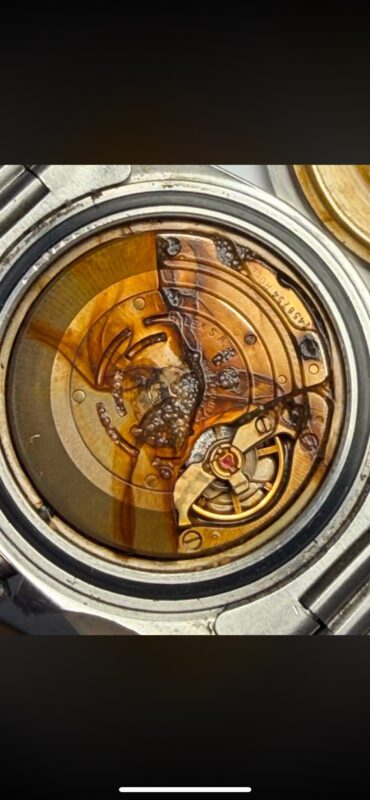
When the sealing gaskets age, they dry out and deform. They lose their elasticity and no longer adhere properly to the crown and pushers. Water finds its way in, enters the case, and begins its silent work. The first symptom is a mark on the dial, condensation under the crystal. The second, often, is the movement stopping. The third, when the client opens the watch, is what you see below.
↓ Here is what happens inside the case
A movement ruined by rust: water entered through a gasket that was never replaced. By this point, the repair costs far more than a water resistance test.
That rust is the result of a seal that had stopped doing its job. No impact, no trauma: simply the wear of time on a rubber gasket that had lost its softness. A €50 water resistance test would have caught the problem before saltwater turned a healthy calibre into a block of oxide.
€50
The cost of the water resistance test 30 minutes – water resistance certificate included
Why the water resistance test costs €50 and is worth every cent
Fifty euros. That is the cost of a restaurant dinner, a pair of good-quality socks, a book. And it is the price of the service that tells you, with certainty, whether your watch can face the summer or should stay at home drying out.
Consider the alternative. A movement rusted by saltwater requires a complete overhaul: total disassembly, replacement of oxidised components, lubrication, regulation. We are talking about figures starting at several hundred euros and potentially exceeding a thousand for a complicated calibre. Not to mention the collector value lost when an original dial is ruined by moisture.
The maths is simple: €50 of prevention against hundreds, sometimes thousands of euros of repair. And above all, against the risk of losing forever a watch that may have been in your family for generations.
What the water resistance test includes
The watch water resistance verification service I offer in my workshop is not a cursory check. It is a complete diagnosis, carried out with professional instruments, that gives you a clear picture of your watch’s sealing condition. Here is what it includes:
1
Dry pressure testThe watch is subjected to an overpressure test in a special chamber, with no direct contact with water. This method, known as a “dry test,” detects any seal leaks in complete safety, with zero risk to the movement. It is the first examination: if the case does not hold pressure, water does not even enter the test.
2
Visual and functional gasket inspectionI examine the crown gasket, the pusher gaskets (chronograph buttons), the case-back gasket, and the crystal. I check the state of elasticity, wear, and deformation. A dry or cracked gasket must be replaced, even if the pressure test passed: because it will soon fail.
3
Condensation (humidity) testA final check that verifies the absence of any trace of moisture inside the case. If the watch has already entered the water without your knowledge, this test will reveal it.
4
Water resistance certificateAt the end of the check, you receive a certificate attesting the test result, the date of execution, and the guaranteed depth of resistance. A document that is also useful for the future value of the watch: it proves the maintenance was carried out, and by whom.
If the test reveals a problem, I explain exactly what is needed: a gasket replacement, a crystal to be restored, a worn crown. No hidden work, no surprise quotes. First the diagnosis, then the decision.
My method: diagnosis before the quote
For 41 years I have worked on luxury mechanical watches. My approach is always the same: first I understand, then I propose. I will never call you to say “you need a €600 service” without first explaining why, showing you what I found inside the case.
The water resistance test is precisely this: an act of diagnosis. It gives you objective information about the state of your watch, and leaves you free to decide. If the seal is good, you head off on holiday with peace of mind. If it is not, you know what you are risking and can choose whether to repair now or keep the watch out of the water this summer.
Book your test before you leave
The ideal time for a watch water resistance check is a few weeks before your holiday. That way, if work on the gaskets is needed, there is time to carry it out without rushing.
Booking is simple. You can message me directly on WhatsApp: Click here to open WhatsApp chat – send me a photo of the watch and tell me when it suits you to come by. Alternatively, use the contact form on the website and I will reply within the day.
The workshop is in Gallarate, in the province of Varese – easily reachable from Milan and Lake Maggiore. The water resistance test is carried out on the same day, by appointment. This service is part of our scheduled maintenance offering, which also includes complete service and repair. For more information, also read our guide on how often to service a Rolex.
Do not wait for the first mark on the dial
The most common mistake is thinking: “my watch is water-resistant to 100 metres, I do not need to check it.” The truth is that water resistance is not a permanent feature. It is a condition that deteriorates over time, with heat, sweat, and gasket wear. A watch that held 100 metres ten years ago today may not even withstand a shower.
That is why the water resistance test should be done at least once a year, or in any case before any prolonged exposure to water. It is minimal maintenance that protects a significant investment.
Before heading off on holiday, treat yourself to the peace of mind of knowing your watch is ready for summer. Fifty euros, half an hour in the workshop, and the certainty that when you return, you will find your watch exactly as you left it.
Frequently asked questions about the water resistance test
How much does the water resistance test cost?
The water resistance test costs €50 at the Strumenti del Tempo workshop in Gallarate. It includes a dry pressure test, gasket inspection, condensation test, and a water resistance certificate.
How long does the water resistance test take?
The water resistance test is carried out on the same day, by appointment. The complete procedure requires approximately 30 minutes in the workshop.
When should I have my watch’s water resistance tested?
The water resistance test should be done at least once a year, or in any case before any prolonged exposure to water. The ideal time is a few weeks before your holiday.
Is a watch’s water resistance permanent?
No, water resistance is not a permanent feature. It is a condition that deteriorates over time, with heat, sweat, and gasket wear. A watch that held 100 metres ten years ago today may not even withstand a shower.
What happens if water enters the watch?
Saltwater corrodes the movement: the first symptom is a mark on the dial or condensation under the crystal, the second is the movement stopping. A rusted movement requires a complete overhaul starting at several hundred euros.
Is the water resistance test safe for the watch?
Yes, the dry pressure test involves no direct contact with water, so it is completely safe for the movement. It detects any seal leaks in complete safety.
📅 Summer Opening – 27 to 31 July: The workshop is open mornings only. Please call to book an appointment before visiting.
Summer Opening – July 27 to 31
The workshop is open mornings only from July 27 to 31. Please call to book an appointment before visiting.
Book your water resistance test
€50 – 30 minutes – Water resistance certificate included
Come funziona il servizio Before You Head to the Sea: Check That Your Watch Is Still Water-Resistant?
Un sopralluogo gratuito fornisce un preventivo scritto preciso e trasparente, senza impegno.
Quanto costa Before You Head to the Sea: Check That Your Watch Is Still Water-Resistant?
Un sopralluogo gratuito fornisce un preventivo scritto preciso e trasparente, senza impegno.
Perché sceglierci per Before You Head to the Sea: Check That Your Watch Is Still Water-Resistant?
Un sopralluogo gratuito fornisce un preventivo scritto preciso e trasparente, senza impegno.
Trusting an independent watchmaker rather than the official network is not merely a financial choice – it is a genuine declaration of intent for any vintage enthusiast.
In the 2026 market, where the distinction between “commercial object” and “historical artefact” is increasingly sharp, the official network often represents a threat to the integrity of the piece.
And this is the principal message we wish to convey to anyone who owns a vintage piece – important or not – bearing a prestigious logo on the dial.
Here are the technical and strategic reasons why the independent wins over the official network in the vintage market:
1. The Original Sin: “Factory Fresh Syndrome”
The major houses have a commercial mission: to return your watch as if it were new. For a vintage collector, this is a nightmare.
Coercive replacements: Official service centres (Rolex and Patek at the forefront) tend to replace tropical dials, tritium-oxidised hands, or faded bezels with modern supply components. In other words, modern parts that are not contemporary with the watch, creating a genuine official “Franken.”
Destruction of value: In a market that recognises and rewards “Mechanical Dignity” and the appeal of the “Relic,” replacing an original dial with a modern one can obliterate up to 80% of a piece’s collector value. The independent, by contrast, works to conserve, not to replace.
2. The Spare Parts Monopoly and “Lock-in”
The major houses, starting with the Swatch Group, are pursuing a “walled garden” strategy to exclude every other actor from their relationship with the end customer.
Gatekeeping: By restricting the supply of spare parts to independents, the houses force owners into their circuit, which represents a significant cost and entails many obligations.
The resistance of independents: A skilled master watchmaker often holds stocks of vintage spare parts (New Old Stock) or possesses the micro-mechanical ability to reconstruct a component on the lathe. Turning to them means supporting an open ecosystem that does not depend on the whims of a marketing office in Geneva.
3. Expertise vs Standardisation
Despite the prestige of the brand, in official service centres your vintage watch may end up on the bench of a young technician accustomed to working on modern modular calibres. You will never know who laid hands – and tweezers – on it.
Mechanical sensitivity: An independent watchmaker who lives and breathes vintage has a “tactile memory” of historical calibres (such as the old Longines, the Omega 321 calibres, or the honest workhorses like the FHF ST 96). They know that 60-year-old metal cannot be treated with the same tightening torque as a 2026 calibre.
Transparency: With the independent, you speak directly with the person who handles the movement. At the official houses, your watch disappears behind a counter for months and you receive only a pre-formatted quote.
4. The Restoration Paradox
If you send a badly damaged vintage watch to the manufacturer, the answer is often: “It is not repairable” or “The movement must be replaced in its entirety.” The Maisons are careful not to mention that any calibre must – by Swiss law – be maintained for ten years from the end of production – yet the independent works with calibres sometimes a hundred years old.
The art of the possible: For an independent, nothing is beyond repair. Where the manufacturer sees an industrial inefficiency to be eliminated with minimal effort, the craftsman sees a restoration challenge. It is the difference between someone who wants to sell you a standardised service and someone who wants to save a piece of history.
The 2026 Verdict
In this era of “Selective Normalisation,” trust shifts from the logo on the shopfront to the skill of the craftsman at the bench. If the watch holds sentimental or collector value (such as your father’s watch or a vintage piece with perfect patina), the official network is a risk you simply cannot afford.
This is why in our workshop we work to build relationships: because it is these that make the difference.
📅 Summer Opening – 27 to 31 July: The workshop is open mornings only. Please call to book an appointment before visiting.
Summer Opening – July 27 to 31
The workshop is open mornings only from July 27 to 31. Please call to book an appointment before visiting.
Book your vintage watch consultation
Conservative restoration – Direct contact with the master watchmaker – Gallarate, near Milan and Lake Maggiore
Workshop in Gallarate (VA) – By appointment only Open mornings only 27–31 July – Please call before visiting
Frequently asked questions
Does the official network refuse to work on vintage watches?
Some centres only accept recent pieces or apply standard replacements that are destructive for vintage. A specialised independent assesses the originality of the piece first.
Does an independent intervention void the warranty?
If the watch is under warranty: go official. Out of warranty, the choice of craftsman is free, and often more respectful of the piece.
How do I recognise an original dial?
Typography, uniform patina, period-consistent markings. Verification is done with a loupe and catalogue comparison: part of our workshop consultation.
How often should a vintage watch be serviced?
It depends on use and condition: a well-preserved vintage movement may need less frequent intervention than a modern one. See the complete service guide.